(no subject)
Nov. 10th, 2018 03:52 pm![[personal profile]](https://www.dreamwidth.org/img/silk/identity/user.png) skygiants
skygiantsSometimes I read a book and wish I was back in an English Lit class so that I could have a formalized way to unpack my thoughts and put them in context with the thoughts of other people. I'm feeling that way about Lud-in-the-Mist, which I did not expect, as my prevailing impression of it before reading it was 'light rural British fantasy that inspired Stardust and other works in that vein.'
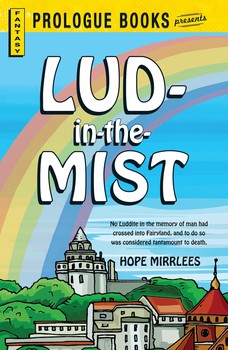
The significant misapprehension here was 'light'. Despite the horrible jaunty yellow cover of my library copy, Lud-in-the-Mist is not a light book. It's about death, and depression, and the fictions that make life bearable.
... and Fairy, which at one point or another in the text stands in for all of those things!
Lud-in-the-Mist centers on Nathaniel Chanticleer, mayor of Lud, capital of Dorimare, which neighbors on Fairy -- but Fairy has been locked out for several centuries, and the profoundly prosaic modern Ludites treat everything to do with it as an obscenity. Unfortunately for the modern Ludites, someone has been smuggling fairy fruit into Lud. Unfortunately for Nathaniel Chanticleer, his son Ranulph -- already kind of a weird kid -- has apparently eaten some of the fruit.
...so does his daughter, eventually, but Nathanial absolutely does not care so much about that. (I cared, and bristled for all the many, many pages during which the narrative gave an enormous shrug about the young ladies of Lud.) On the other hand, the only reason Nathaniel cares about Ranulph is due to a moment towards the start of the book, when he recognizes his own habitual melancholy in his son and for the absolute first time becomes EXTREMELY INVESTED. The pattern for a good father, Nathaniel Chanticleer is not. He's a masterfully-drawn character, though, a bundle of depression and unease and yearning/fear after something unknown wrapped up in the hearty bluff outside of a small-town bourgeois -- not a hero I expected, or that anyone expects in-text either.
In the end, the borders between Fairy and Lud have to come down, and do -- but it's a strange conclusion, because it's not like Fairy makes a single person in this book happy, or brings any kind of joy. To me, the conclusion seems to come as a kind of profound, sad inevitability: Fairy's a weird, wild misery, but it's better to acknowledge it than to lock it away, and replace it with another set of fictions.
I do find it interesting that of all the things that have been taken from Lud-in-the-Mist over the years and put into other books, the thing that doesn't seem to come along with it particularly is the explicit link between the land of Fairy and the land of the dead.
(I guess you could make a case that it does in Jonathan Strange and Mr. Norrell, but it comes across quite differently there than the deep discomfort of Lud-in-the-Mist -- JSMN takes away the hope of peace for those who dwell too deeply in magic, but Lud-in-the-Mist won't promise peace for anyone at all.
The significant misapprehension here was 'light'. Despite the horrible jaunty yellow cover of my library copy, Lud-in-the-Mist is not a light book. It's about death, and depression, and the fictions that make life bearable.
... and Fairy, which at one point or another in the text stands in for all of those things!
Lud-in-the-Mist centers on Nathaniel Chanticleer, mayor of Lud, capital of Dorimare, which neighbors on Fairy -- but Fairy has been locked out for several centuries, and the profoundly prosaic modern Ludites treat everything to do with it as an obscenity. Unfortunately for the modern Ludites, someone has been smuggling fairy fruit into Lud. Unfortunately for Nathaniel Chanticleer, his son Ranulph -- already kind of a weird kid -- has apparently eaten some of the fruit.
...so does his daughter, eventually, but Nathanial absolutely does not care so much about that. (I cared, and bristled for all the many, many pages during which the narrative gave an enormous shrug about the young ladies of Lud.) On the other hand, the only reason Nathaniel cares about Ranulph is due to a moment towards the start of the book, when he recognizes his own habitual melancholy in his son and for the absolute first time becomes EXTREMELY INVESTED. The pattern for a good father, Nathaniel Chanticleer is not. He's a masterfully-drawn character, though, a bundle of depression and unease and yearning/fear after something unknown wrapped up in the hearty bluff outside of a small-town bourgeois -- not a hero I expected, or that anyone expects in-text either.
In the end, the borders between Fairy and Lud have to come down, and do -- but it's a strange conclusion, because it's not like Fairy makes a single person in this book happy, or brings any kind of joy. To me, the conclusion seems to come as a kind of profound, sad inevitability: Fairy's a weird, wild misery, but it's better to acknowledge it than to lock it away, and replace it with another set of fictions.
I do find it interesting that of all the things that have been taken from Lud-in-the-Mist over the years and put into other books, the thing that doesn't seem to come along with it particularly is the explicit link between the land of Fairy and the land of the dead.
(I guess you could make a case that it does in Jonathan Strange and Mr. Norrell, but it comes across quite differently there than the deep discomfort of Lud-in-the-Mist -- JSMN takes away the hope of peace for those who dwell too deeply in magic, but Lud-in-the-Mist won't promise peace for anyone at all.


no subject
Date: 2018-11-10 11:34 pm (UTC)Yes! That is one of the things I love deeply about Lud-in-the-Mist; it is weirdness old enough in our world that the fairy ballads are shot through with it (the teind to Hell, the road to Elfland is the road between the road to Heaven and the road to Hell) and I agree that the only modern author to do much with it since Mirrlees is Susanna Clarke. It shows up in Francis Stevens' "The Elf-Trap" (1919), which I was pointed to this summer after a discussion about Lud-in-the-Mist. I think I may have seen it surface in some recent dark fairy fiction, but never as thoroughly as Mirrlees did it. "They called them both the 'Silent People'; and the Milky Way they thought was the path along which the dead were carried to Fairyland."
That is a terrible cover. I'm not saying the edition I have is better. I just hope the book got a decent cover sometime.
no subject
Date: 2018-11-11 04:25 pm (UTC)ETA Also potentially relevant as backdrop (besides the ballads, on which I fully agree): Sir Orfeo (modernized). Tolkien translated it into modern English, too.
no subject
Date: 2018-11-14 04:24 am (UTC)The cover is so astoundingly bad! I picked the book up at the library and was just like '....I am FAIRLY SURE this is not an accurate representation of the contents.'
no subject
Date: 2018-11-14 05:32 am (UTC)For whatever it's worth, it makes sense to me.
no subject
Date: 2018-11-11 12:01 am (UTC)no subject
Date: 2018-11-14 04:25 am (UTC)no subject
Date: 2018-11-14 04:29 am (UTC)no subject
Date: 2018-11-11 06:13 am (UTC)As I think I told you, I keep thinking I've read Lud-in-the-Mist, but what I have in fact read is The King of Elfland's Daughter, which is another early fantasy book involving Fairy and its borders but otherwise extremely different.
Did you ever read Margaret Oliphant's A Beleaguered City? It was written about 40 years earlier than the other two, but it has a sort of a weird melancholy ambiguity to its treatment of death and grief and unease and the borders between the living world and the world of the dead, in its way. Now I sort of want to reread it and The King of Elfland's Daughter and read Lud-in-the-Mist and just kind of set them mentally next to each other and see what comes of it. (A lot of inarticulate handwaving at my friends, probably, but maybe something more coherent also.)
no subject
Date: 2018-11-14 04:26 am (UTC)no subject
Date: 2018-11-14 04:50 am (UTC)I should read that—Oliphant's "The Open Door" (1882) is the earliest instance I've discovered of the now almost taken for granted idea of a ghost as an imprint on time, as a pattern that must be broken to be exorcised.
no subject
Date: 2018-11-11 08:36 am (UTC)Have you read the King of Elfland's Daughter? It's another Fairy-swallows-England story, more relentlessly upbeat though. Also more charming goblins. ALSO WAIT a more important question, have you read Sylvia Townsend Warner's Kingdoms of Elfin, it's the closest thing I can think of to Lud-in-the-Mist in terms of highly wrought deadpan nastiness, although much more in the "fairies are basically humans and it sucks" vein rather than "humans are basically fairies and it sucks"
no subject
Date: 2018-11-14 04:31 am (UTC)I have read neither of those books but in particular I should read the Warner -- Summer Will Show was my first Warner last year (aside from the T.H. White bio, which only sort of counts) and it took me several months to recover from the impact.
no subject
Date: 2018-11-14 09:04 pm (UTC)no subject
Date: 2018-11-14 11:42 pm (UTC)(though it's not like one couldn't do Summer Will Takarazuka Show. Reuse the Les Mis sets -)
no subject
Date: 2018-11-12 01:51 am (UTC)I went through a minor Mirrlees phase about ten years ago and it's still one of the books I think about the most--also one of the most influential fantasy novels of all, if you think of Neil Gaiman, Susanna Clarke, and Garth Nix all producing books that were heavily influenced by this book. Apparently I concluded that Chanticleer is an Eleusinian intitiate, but I'd have to reread the book to remember my reasoning.
no subject
Date: 2018-11-14 04:34 am (UTC)Did you end up reading any other Mirrlees at that time? Until I looked her up afterwards, I had no idea that she had in fact written any other fiction, and now I find myself very curious.
no subject
Date: 2018-11-14 04:49 am (UTC)On grounds of Jane Ellen Harrison, I'd believe it.